Kirilov
The Myth of SisyphusKirilov is the engineer in Fyodor Dostoevsky’s The Possessed whose suicide becomes the most concentrated expression of logical suicide in the novel. He believes that if God does not exist, human beings must assume complete responsibility for existence; yet, instead of living out that independence, he prepares to die in order to prove it. His death is therefore at once philosophical demonstration, metaphysical revolt, sacrifice for humanity, and an absurd reversal in which freedom is established through self-destruction.
Identity and Philosophical Premise
Kirilov belongs to the modern world described through metaphysical rather than merely moral questions. Like Dostoevsky’s other heroes, he asks what life means, but his inquiry is driven toward an extreme solution: existence must be either illusory or eternal. He does not treat this as an abstract puzzle. The question becomes a demand placed upon his own body and future, until thought requires an action that will validate it.
His central proposition is that, if God does not exist, he himself is god. This is not presented as ordinary religious identification or as a megalomaniac’s fantasy. Kirilov’s divinity is terrestrial. He defines its attribute as independence: without an immortal being on whom everything depends, everything depends on human beings themselves. To become god is consequently to become free on earth, to refuse service to a transcendent authority, and to draw every consequence from that painful independence.
Character and Contradiction
The force of Kirilov’s idea depends on the ordinary human material from which it arises. He performs gymnastics each morning to preserve his health, is moved by the happiness of Chatov recovering his wife, and is capable of childishness, irritability, passion, method, and sensitivity. A sheet of paper found after his death is meant to bear a face sticking out its tongue at “them,” an almost childish gesture set beside his calm assertion of divinity. He possesses the logic and obsession of a superman, but otherwise retains the full catalogue of human traits.
This combination prevents his claim from being reduced to madness. When he explains himself to Stavrogin, he distinguishes his position from that of a god-man and instead annexes the meaning of Jesus Christ. Kirilov imagines that Jesus Christ, at death, discovered that his torture had been useless and that the laws of nature had made him live amid falsehood and die for a falsehood. In this interpretation, Jesus Christ is not divine in the conventional sense but the complete man, the man-god who realizes the most absurd human condition. Every person can therefore be crucified and victimized to some degree, while Kirilov attempts to convert that victimization into conscious independence.
The contradiction is explicit. If freedom is achieved by the disappearance of God, why should the newly free person leave the world? Kirilov knows that the truly liberated person should live “covered with glory,” as a tsar rather than kill himself. His own decision nevertheless makes suicide necessary. The project thus turns against its premise: life is the sphere in which independence should be exercised, but death becomes the chosen proof that independence has been attained.
Suicide as Revolt and Sacrifice
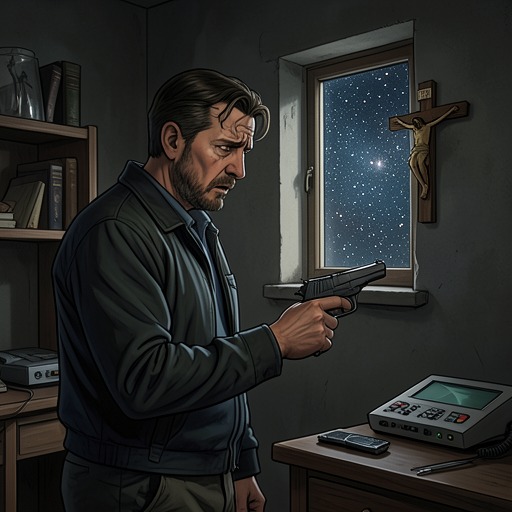
Kirilov’s preparation for death combines indifference, revolt, and freedom. He accepts that his suicide will be used for a political cause he despises, declaring that he had decided he did not care. Yet this indifference does not exhaust his motive. He also states that he will kill himself to assert his insubordination and his new, dreadful liberty. His act is not simply despair, nor is it merely revenge against the conditions of existence. It is intended as a public metaphysical act whose meaning exceeds the individual who performs it.
The deepest formulation of his plan is that he wants to kill himself to become god. The logic is stark: if God does not exist, Kirilov is god; if he is god, he must kill himself; therefore he must kill himself to become god. The reasoning is absurd in its conclusion but precise in its movement. It translates divine eternity into an earthly act and treats the pistol shot as the final sign that no external power retains authority over him.
His suicide is also pedagogical. Kirilov believes that ordinary people do not feel the independence he has discovered. They remain bound to blind hopes and need someone to show them the royal and difficult path. He therefore sacrifices himself as the first traveler on that path, imagining that his death will teach his brothers what freedom means. He is crucified, in effect, but refuses to regard himself as merely victimized. His suffering acquires the form of a demonstration offered to humanity.
Consequences and Afterlife in Other Characters
Kirilov’s imagined consequences extend beyond his own death. Once he is dead and people are enlightened, he expects the earth to be populated by tsars and illuminated by human glory. His pistol shot is to signal the last revolution, a collective transformation in which each person possesses the independence he has tried to make visible. The political and spiritual scale of this expectation gives the act its strange mixture of grandeur and futility.
His final emotional register is not simple despair. Before ending his spiritual adventure in blood, he voices the old observation that “All is well.” The phrase stands against the violence of the act and reveals the peculiar calm within his fatal logic: he believes that his death can reconcile suffering, freedom, and love of one’s neighbor, even though the reconciliation remains internally impossible.
Kirilov’s death also releases other characters into related experiments with absurd truth. Stavrogin and Ivan Karamazov try to enact in practical life what Kirilov has reached through metaphysical reasoning. Stavrogin becomes a tsar in indifference, leading an ironic life and arousing hatred while insisting in his farewell letter that he has been unable to detest anything. Ivan Karamazov retains the royal powers of the mind and refuses the demand that belief requires humiliation, moving toward the principle that everything is permitted. Kirilov’s suicide therefore does not close the argument; it becomes the opening through which other forms of freedom, indifference, and moral danger enter the world.
Narrative and Thematic Significance
Kirilov embodies the absurd character with a decisive reservation: he recognizes the contradiction of his position but kills himself anyway. His importance is not that he offers a successful answer to the absence of God. Rather, he dramatizes how a lucid demand for freedom can become an absolute command, and how the desire to free humanity can reproduce the logic of sacrifice. His thought begins by rejecting transcendence, but it retains a quasi-religious structure: revelation, martyrdom, disciples, and a promised transformation of the earth.
Through Kirilov, logical suicide becomes both an intellectual conclusion and a human drama. The engineer’s body carries the cost of a proposition that cannot remain theoretical. His ordinary gestures, emotional responsiveness, and methodical habits keep the doctrine attached to lived humanity, while his planned death pushes that humanity toward an impossible divinity. He is thus neither simply a madman nor simply a philosopher. He is an artistically realized figure of the absurd, in whom independence becomes sacred, suicide becomes instruction, and the attempt to conquer metaphysical abandonment ends by making death the final language of freedom.